Volume: 14 Issue: 2
Knowledge Gain and Student Perceptions Following Two Methods of Early Clinical Exposure in Physiology among First-Year MBBS Students
Year: 2026, Page: 13-19, Doi: https://doi.org/10.47799/pimr.1402.26.79
Received: June 19, 2026 Accepted: July 20, 2026 Published: Aug. 31, 2026
Abstract
Introduction: Early clinical exposure (ECE) is an integral component of the competency-based undergraduate medical curriculum in India and can be delivered through different instructional methods. Evidence directly comparing different ECE methods in the same group of students is limited. This study compared knowledge gain following case-scenario and video-assisted lecture methods of ECE and assessed students' perceptions of these approaches. Methods: This educational interventional study employed a two-period, two-topic crossover design involving 96 first-year MBBS students in the Department of Physiology during November–December 2024. Students received ECE on two topics using both case-scenario and video-assisted lecture methods in a crossover sequence. Knowledge was assessed using identical pre-test and post-test questionnaires. Students' perceptions were evaluated using a structured questionnaire and open-ended feedback. Knowledge gain was analysed using paired statistical tests and a linear mixed-effects crossover model. Results: Significant improvement in post-test scores was observed following both teaching methods (p<0.001). The crossover analysis showed no significant difference in knowledge gain between the two methods, although a significant topic effect was observed (p<0.001). More than 96% of students agreed that ECE improved interest, understanding of clinical relevance and its application. Students preferred case-scenario method for maintaining attention, motivating further learning and developing empathy. Conclusions: Both case-scenario and video-assisted lecture methods of ECE significantly improved immediate knowledge among first-year MBBS students. Although knowledge gain was comparable between the two approaches, students showed greater preference for case scenarios. The findings support the complementary use of both methods while planning ECE sessions in undergraduate medical education.
Keywords: Early Clinical Exposure, Competency-Based Medical Education, Physiology, Medical Education, Case-scenario, Video-assisted lecture, Student perception
INTRODUCTION
Early Clinical Exposure (ECE) is a teaching-learning method that introduces medical students to the clinical environment from the first year of training, well before the formal clinical postings begin. In India, the National Medical Commission (NMC) has incorporated ECE as a mandatory longitudinal component of the Competency-Based Medical Education (CBME) curriculum for the first-year MBBS course, in keeping with the goals of the Indian Medical Graduate[1]. By linking basic science concepts with their clinical relevance early in the course, ECE is intended to make preclinical learning more meaningful and to support the development of professional competencies from the outset.
The educational benefits of ECE have been reported in several studies and reviews. ECE increases students' interest in learning, improves motivation, facilitates better understanding of basic science concepts and promotes professional attitudes by placing classroom learning in a clinical context[2, 3, 4]. Early patient contact also encourages the development of communication skills, empathy and clinical reasoning, making learning more meaningful and relevant[5, 6]. Sathishkumar et al. demonstrated that ECE in Endocrine Physiology enhanced students' interest, improved conceptual understanding and increased sensitivity towards patient care[7]. Similar findings have been reported from Indian medical colleges, where first-year MBBS students perceived ECE as an engaging teaching-learning strategy that improved their understanding of Physiology and increased their appreciation of its clinical relevance[8, 9]. Integrated ECE programmes in Physiology have also been found feasible and acceptable to both students and faculty[10]. Faculty members have recognised the educational value of simulation-based ECE while identifying practical issues related to its implementation[11]. A recent systematic review further concluded that ECE contributes positively to knowledge acquisition, professional development, communication skills and learner confidence across a variety of educational settings[12].
ECE can be implemented using different instructional approaches depending on the learning objectives and available resources. The NMC recommends several formats, including encounters with real or simulated patients, case-based discussions, simulations, demonstrations and multimedia-assisted teaching[1]. Case-scenario-based sessions encourage active participation, clinical reasoning and application of basic science knowledge, whereas video-assisted lectures provide standardised demonstrations of clinical conditions and reinforce learning through audiovisual material. Both approaches aim to achieve the objectives of ECE, but they differ in the way students engage with clinical problems.
Most published studies have evaluated ECE against conventional classroom teaching or have described the effectiveness of a single ECE strategy[2, 3, 4]. Direct comparisons between different ECE methods using the same group of students are relatively few, and evidence on students' preferences for different ECE formats is limited. Such information could help faculty select appropriate teaching methods while planning ECE sessions within the constraints of time, infrastructure and faculty availability.
The present study was therefore undertaken among first-year MBBS students in Physiology to compare two commonly used ECE methods within the same cohort. The objectives were: (i) to compare the immediate change in knowledge scores following a case-scenario-based session and a video-assisted lecture session; and (ii) to compare and explore students' perceptions of the two methods.
MATERIALS AND METHODS
Study design and setting: This educational study employed a two-period, two-topic crossover design and was conducted in the Department of Physiology of a tertiary care teaching hospital during November and December 2024. Each student underwent both teaching methods for two different topics and served as his or her own control.
Study participants: All first-year MBBS students of the 2024 batch were eligible to participate. Students who were absent during either teaching session or who did not complete the pre-test, post-test or feedback questionnaire were excluded from the analysis. A total of 96 students completed both sessions and were included in the study. A formal sample-size calculation was not performed; all available students of the batch were included.
Ethical Approval: The study was approved by the Institutional Ethics Committee (Approval No. 01/IEC/2024). Written informed consent was obtained from all participants before enrolment. Participation was voluntary, and confidentiality of the collected data was maintained throughout the study.
Study procedure: Students were allocated into two groups of 48 by randomization. Two Physiology topics, oedema and anaemia, were selected for the study. In the first session, Group 1 was taught oedema using the case-scenario method, while Group 2 received the same topic through a video-assisted lecture. During the second session, the groups crossed over. Group 2 learnt anaemia by the case-scenario method, whereas Group 1 received a video-assisted lecture on the same topic. Thus, each student was exposed to both teaching methods during the study period, and each topic was taught by both methods to different groups.
Teaching methods: In the case-scenario method, students were introduced to a structured clinical case related to the topic. They were encouraged to analyse the clinical findings, discuss the underlying physiological mechanisms and correlate them with the patient's presentation through interactive discussion.
In the video-assisted lecture method, the same topic was taught using a structured lecture supported by short clinical videos, charts and images. The sessions emphasised the physiological basis of disease and its clinical application.
Both teaching sessions were conducted by faculty members of the Department of Physiology. Each session lasted 60 minutes and covered identical learning objectives and course content.
Knowledge assessment: Knowledge was assessed using a structured questionnaire comprising ten multiple-choice questions for each topic. The questionnaire was prepared by departmental faculty based on the predefined learning objectives. The same questionnaire was administered immediately before and immediately after each teaching session. Each correct response was awarded one mark, giving a maximum score of ten.
Student perception: Students' perceptions of the two teaching methods were assessed using a structured feedback questionnaire administered after completion of both sessions. The questionnaire consisted of five statements assessing interest, retention of knowledge, understanding of clinical relevance, assimilation of concepts and application of knowledge, rated on a five-point Likert scale. Students also rated the perceived improvement in knowledge, satisfaction, confidence, liking and enjoyment using percentage categories ranging from 0–20% to 81–100%. The questionnaire was reviewed by three faculty members for content validity and pilot-tested before the study. The internal consistency of the perception scale was good (Cronbach’s alpha 0.86 for the five Likert items and 0.90 for the full ten-item questionnaire).
Open-ended feedback: Students were asked five open-ended questions regarding the teaching method they found more useful for understanding the topic, maintaining attention, motivating further learning and improving sensitivity towards patients. Responses were reviewed independently by two faculty members and grouped into common themes.
Statistical analysis: Data were entered in Microsoft Excel and analysed using SPSS version 20 (IBM Corp., Armonk, NY, USA). Continuous variables are presented as mean ± standard deviation, while categorical variables are expressed as frequencies and percentages. Pre-test and post-test scores were compared using the paired t-test, with the mean change, its 95% confidence interval and effect size (Cohen's d) reported. Knowledge gain between the two teaching methods was compared using paired analysis, considering each student as his or her own control, and a linear mixed-effects model was fitted with knowledge gain as the outcome and teaching method, period/topic and sequence as fixed effects and the student as a random effect. The internal consistency of the perception questionnaire was assessed using Cronbach’s alpha. A p value of <0.05 was considered statistically significant. As the study was not designed as an equivalence trial, a non-significant difference between the methods was interpreted as the absence of a detected difference rather than as evidence of equal effectiveness.
RESULTS
Participant characteristics: Ninety-six first-year MBBS students participated in the study. Their mean age was 18.79 ± 0.94 years; 50 (52.1%) were female and 46 (47.9%) were male.
Knowledge scores: Post-test scores were higher than pre-test scores following both teaching sessions. For oedema, the mean score increased from 6.16 to 8.71, and for anaemia from 5.83 to 9.24. Both improvements were statistically significant (p<0.001), with large effect sizes. By teaching method, the mean difference between post-test and pre-test scores was 3.16 marks for the case-scenario method and 2.80 marks for the video-assisted lecture method [Table. 1].
| Category | Pre-test (mean ± SD) |
Post-test (mean ± SD) |
Mean difference (95% CI) |
p value | Effect size (d) |
|---|---|---|---|---|---|
| By topic | |||||
| Oedema | 6.16 ± 1.71 | 8.71 ± 1.51 | 2.55 (2.17–2.94) | <0.001 | 1.34 |
| Anaemia | 5.83 ± 1.45 | 9.24 ± 1.27 | 3.41 (3.08–3.74) | <0.001 | 2.09 |
| By method | |||||
| Case-scenario | 5.91 ± 1.56 | 9.06 ± 1.41 | 3.16 ± 1.87 | — | — |
| Video-assisted lecture | 6.08 ± 1.61 | 8.89 ± 1.43 | 2.80 ± 1.76 | — | — |
Table 1: Pre-test and post-test scores by topic and by teaching method (n = 96)
CI, confidence interval; SD, standard deviation. Mean difference is post-test minus pre-test; effect size is Cohen's d for paired data (within-session). Scores are out of 10. Between-method comparison is reported in [Table. 2].
Comparison of the two methods (crossover analysis): The linear mixed-effects model showed no significant difference in knowledge gain between the case-scenario and video-assisted lecture methods (adjusted mean difference 0.35 marks; 95% CI −0.08 to 0.79; p=0.11). A significant period effect was observed, with greater knowledge gain during the second session (adjusted mean difference 0.85 marks; 95% CI 0.42–1.29; p<0.001). The sequence effect was not statistically significant (p=0.77) [Table. 2].
Student perception: Most students agreed with the five statements evaluating the ECE sessions, with overall agreement (strongly agree, moderately agree and agree combined) ranging from 96.9% to 99.0% across the five domains [Table. 3]. In the self-assessment section, 77 (80.2%) students reported at least 61% improvement in knowledge, while corresponding proportions were 82 (85.4%) for satisfaction, 83 (86.5%) for confidence, 85 (88.5%) for liking the teaching method and 88 (91.7%) for enjoyment of the learning process [Table. 4].
| Factor | Adjusted effect (marks) |
95% CI | p value |
|---|---|---|---|
| Teaching method (case-scenario vs video-assisted lecture) |
+0.35 | −0.08 to 0.79 | 0.11 |
| Period/topic (second session, anaemia vs first, oedema) |
+0.85 | 0.42 to 1.29 | <0.001 |
| Sequence (case-first vs video-first) |
−0.08 | −0.64 to 0.47 | 0.77 |
Table 2: Mixed-effects (crossover) analysis of knowledge gain (n = 96; 192 observations)
Linear mixed-effects model: knowledge gain as outcome; teaching method, period/topic and sequence as fixed effects; student as random effect.
Preference between the two methods: More students preferred the case-scenario method for maintaining attention, motivating further reading and improving sensitivity towards patients. Preferences for understanding a new topic were more evenly distributed, with approximately half preferring the case-scenario method and about one-third preferring the video-assisted lecture [Fig. 1]. The main themes identified from the open-ended responses, with representative quotes, are presented in [Table. 5].
| Statement | Strongly agree |
Moderately agree |
Agree | Disagree | Strongly disagree |
|---|---|---|---|---|---|
| Aroused interest in the topic | 35 (36.5%) | 32 (33.3%) | 28 (29.2%) | 1 (1.0%) | 0 |
| Helped in better retention | 35 (36.5%) | 31 (32.3%) | 28 (29.2%) | 2 (2.1%) | 0 |
| Imparted better clinical context | 48 (50.0%) | 22 (22.9%) | 25 (26.0%) | 1 (1.0%) | 0 |
| Allowed better assimilation | 33 (34.4%) | 35 (36.5%) | 25 (26.0%) | 3 (3.1%) | 0 |
| Will help apply the knowledge | 44 (45.8%) | 21 (21.9%) | 29 (30.2%) | 1 (1.0%) | 1 (1.0%) |
Table 3: Student agreement with statements about the ECE sessions (n = 96)
| Outcome | 0-20% n (%) |
21-40% n (%) |
41-60% n (%) |
61-80% n (%) |
81-100% n (%) |
≥61% n (%) |
|---|---|---|---|---|---|---|
| Knowledge enhancement | 1 (1.0) | 3 (3.1) | 15 (15.6) | 49 (51.0) | 28 (29.2) | 77 (80.2) |
| Satisfaction | 1 (1.0) | 2 (2.1) | 11 (11.5) | 47 (49.0) | 35 (36.5) | 82 (85.4) |
| Confidence | 2 (2.1) | 6 (6.3) | 5 (5.2) | 48 (50.0) | 35 (36.5) | 83 (86.5) |
| Liking of the teaching method | 1 (1.0) | 0 | 10 (10.4) | 42 (43.8) | 43 (44.8) | 85 (88.5) |
| Enjoyment of the learning process | 2 (2.1) | 1 (1.0) | 5 (5.2) | 41 (42.7) | 47 (49.0) | 88 (91.7) |
Table 4: Students' self-rated improvement following the ECE sessions (n = 96)
≥61% represents the combined responses in the 61–80% and 81–100% categories.
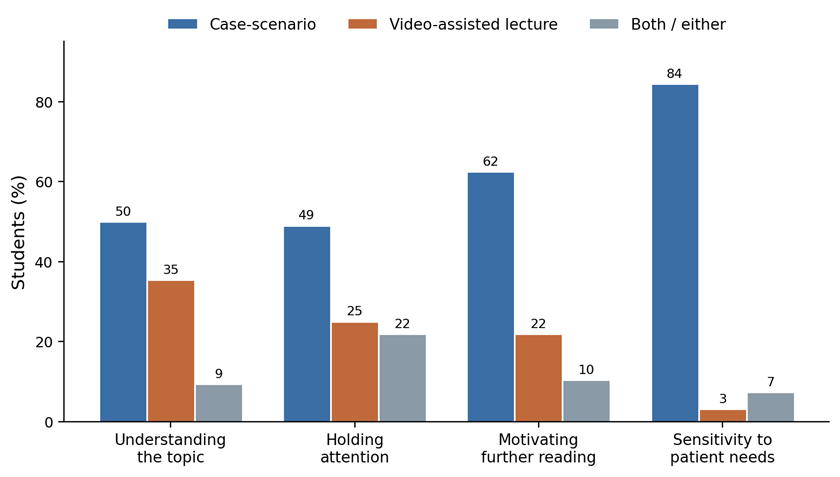
Fig. 1: Teaching method preferred by students on the four open-ended questions (n = 96). Data are presented as percentages; 'other/none' responses (4–5%) are not shown
| Theme | Representative response | Students, n (%) |
|---|---|---|
| Clinical relevance and application to real patients | “It was interactive and we can apply it in a live situation … not just theory but also clinical based.” | 92 (96%) |
| Improved understanding and retention of concepts | “I was able to imagine the case scenario, hence understood the concept easily.” | 68 (71%) |
| Curiosity and motivation for further reading | “Case scenarios … it makes some kind of curiosity, like what will be the cause of this?” | 41 (43%) |
| Usefulness of visual aids (charts, pictures, videos) | “Picture-based learning helps us to memorise easily and is more understandable.” | 39 (41%) |
| Lectures useful for building the basics of a new topic (divergent) | “The lecture method was easy to understand since the topic was completely new.” | 6 (6%) |
Table 5: Themes identified from students' open-ended responses, with representative quotations (n = 96)
Frequencies denote the number of students expressing each theme in the open-ended responses; a student could express more than one theme.
DISCUSSION
In this crossover study, both the case-scenario and video-assisted lecture methods of early clinical exposure (ECE) produced significant improvement in immediate post-test scores with large effect sizes. No statistically significant difference in knowledge gain was observed between the two teaching methods. Students, however, showed a clear preference for the case-scenario method for maintaining attention, promoting interaction and developing sensitivity towards patients, whereas a proportion preferred the video-assisted lecture for understanding an unfamiliar topic.
The significant improvement in knowledge following both teaching methods is consistent with previous reports demonstrating the educational value of ECE. In a systematic review of 15 studies involving 2,579 medical students, Shaban et al. concluded that ECE improves knowledge acquisition, communication skills, professionalism, confidence and empathy[12] Similarly, Tayade and Latti reported that ECE facilitates integration of basic and clinical sciences, improves academic performance and enhances students' confidence[2]. In Physiology teaching, Sathishkumar et al. observed improved understanding, retention and interest following ECE in Endocrine Physiology[7] while Yan et al. reported favourable learning outcomes and high student acceptance of classroom-based ECE in Gastrointestinal Physiology[13]. The present study extends these observations by comparing two different ECE methods using a crossover design in which each student experienced both teaching approaches.
Although both methods resulted in significant improvement in knowledge, no significant difference in knowledge gain was detected between the case-scenario and video-assisted lecture methods. The findings support the concept that the effectiveness of ECE depends primarily on providing meaningful clinical context rather than on a single mode of delivery. The National Medical Commission recommends several approaches to ECE, including real and simulated patients, case-based discussions and multimedia-assisted teaching[1]. Tayade and Latti also described successful implementation of ECE through classroom, hospital and community-based settings[2]. Similarly, Yan et al. found comparable learning outcomes using classroom-based ECE supported by direct physician involvement[13]. These observations, together with the findings of the present study, suggest that different instructional approaches can achieve similar short-term learning outcomes when the learning objectives and clinical context are comparable.
Despite similar knowledge gains, students expressed a clear preference for the case-scenario method. They considered it more effective in maintaining attention, stimulating further reading and improving sensitivity towards patient care. The interactive nature of case scenarios encourages students to analyse clinical findings, relate them to physiological mechanisms and actively participate in the learning process. Spencer et al. described similar advantages of patient-oriented learning, emphasising that authentic clinical situations enhance motivation and educational relevance[6]. The systematic review by Shaban et al. also identified improved engagement, motivation and empathy as important outcomes of ECE[12]. The qualitative responses obtained in the present study reflected these attributes, with students frequently highlighting interaction, clinical relevance and curiosity as the major strengths of the case-scenario method.
The video-assisted lecture method should not be considered less effective, as it also produced substantial improvement in knowledge scores. Many students preferred this method for understanding a new topic because it provided a systematic explanation of basic concepts before their clinical application. Video-assisted lectures also offer practical advantages by ensuring uniform delivery of content and are easier to implement for large batches where faculty time and clinical resources may be limited. Rather than considering one method superior to the other, the findings indicate that the two approaches complement each other. Video-assisted lectures may be useful for introducing fundamental concepts, whereas case-scenario sessions may be more appropriate for reinforcing learning, promoting clinical reasoning and encouraging active participation. Such a blended approach is consistent with the concept of vertical integration between basic and clinical sciences described by Savitha et al. and Dahle et al.[10, 14].
Students' perception of ECE was highly favourable. Most participants agreed that the sessions improved interest in the topic, retention of knowledge, understanding of clinical relevance, assimilation of concepts and application of knowledge. Similar positive perceptions have been reported by Chari et al. and Rajya Lakshmi et al., who found that ECE increased motivation and helped first-year MBBS students appreciate the clinical relevance of Physiology[8, 9]. These findings indicate that ECE not only improves immediate learning outcomes but also enhances students' acceptance of the teaching-learning process during the pre-clinical phase.
Strengths and limitations:
The crossover design was the major strength of this study, as each student experienced both teaching methods and served as his or her own control, thereby reducing inter-student variability. In addition, each topic was delivered using both teaching methods, minimising the influence of the teaching topic on the comparison. The study also has certain limitations. It was conducted in a single institution with one batch of students, limiting the generalisability of the findings. Knowledge was assessed only immediately after the sessions, and long-term retention was not evaluated. The same questionnaire was used for the pre-test and post-test, introducing the possibility of a testing effect. The sample size was modest, and no formal sample-size calculation was performed. Although the perception questionnaire demonstrated good internal consistency (Cronbach's alpha 0.90), it was not subjected to extensive validation and assessed students' perceptions of the sessions as a whole rather than of each teaching method separately[15].
CONCLUSION
Both the case-scenario and video-assisted lecture methods of early clinical exposure produced significant improvement in immediate knowledge among first-year MBBS students. No significant difference in knowledge gain was observed between the two methods, although students showed greater preference for the case-scenario approach because of its interactive nature and perceived clinical relevance. Video-assisted lectures remained useful for introducing new concepts and standardising teaching. The findings suggest that these two approaches are complementary and may be used together while planning ECE sessions in undergraduate medical education.
DISCLOSURE
Conflicts of interest: None declared.
Funding: None.
Acknowledgements: This work was carried out as part of the Advanced Course in Medical Education (ACME) at the NMC Nodal Centre for the National Faculty Development Programme. We thank the students who participated in the study.
References
1. National Medical Commission. Competency based undergraduate curriculum for the Indian Medical Graduate, 2018 (including the early clinical exposure module). New Delhi: Medical Council of India; 2018. Available from: https://www.nmc.org.in/wp-content/uploads/2020/08/Early_Clinical_Exposure-MBBS-07.08.2019.pdf
2. Tayade MC, Latti RG. Effectiveness of early clinical exposure in medical education: Settings and scientific theories – Review. Journal of Education and Health Promotion. 2021; 10 (1). Available from: https://doi.org/10.4103/jehp.jehp_988_20
3. Gupta K, Gill GS, Mahajan R. Introduction and Implementation of Early Clinical Exposure in Undergraduate Medical Training to Enhance Learning. International Journal of Applied and Basic Medical Research. 2020; 10 (3). Available from: https://doi.org/10.4103/ijabmr.ijabmr_270_20
4. Warkar AB, Asia AA. Introduction to early clinical exposure as learning tool in physiology. Indian Journal of Physiology and Pharmacology. 2021; 64 Available from: https://doi.org/10.25259/ijpp_281_2020
5. Johnson AK, Scott CS. Relationship between early clinical exposure and first-year studentsʼ attitudes toward medical education. Academic Medicine. 1998; 73 (4). Available from: https://doi.org/10.1097/00001888-199804000-00018
6. Spencer J, Blackmore D, Heard S, McCrorie P, McHaffie D, Scherpbier A, et al. Patient‐oriented learning: a review of the role of the patient in the education of medical students. Medical Education. 2000; 34 (10). Available from: https://doi.org/10.1046/j.1365-2923.2000.00779.x
7. Sathishkumar S, Thomas N, Tharion E, Neelakantan N, Vyas R. Attitude of medical students towards Early Clinical Exposure in learning endocrine physiology. BMC Medical Education. 2007; 7 (1). Available from: https://doi.org/10.1186/1472-6920-7-30
8. Chari S, Gupta M, Gade S. The Early Clinical Exposure Experience Motivates First Year MBBS Students: A Study. International Journal of Educational Sciences. 2015; 8 (2). Available from: https://doi.org/10.1080/09751122.2015.11890261
9. Rajya Lakshmi N, Dharwadkar AA, Mohanty S, Gayatri N, Vadapalli K. Perception of 1st year MBBS students on early clinical exposure with horizontal integration as a teaching-learning method. Journal of Basic and Clinical Research. 2016; 3 (1). Available from: https://www.researchgate.net/publication/331345266_Perception_of_1st_year_MBBS_students_on_Early_Clinical_Exposure_with_Horizontal_Integration_as_a_teaching_Learning_method
10. Savitha D, Iyengar A, Devarbhavi H, Mathew T, Kuttappa K, Rao S, et al. Early clinical exposure through a vertical integration programme in physiology. The National Medical Journal of India. 2018; 31 (5). Available from: https://doi.org/10.4103/0970-258x.261191
11. Shastry N, Ullal NA, Thattil AM, Maitreyee DS, Bangera SR, Mahmood LS. Faculty perceptions of the efficacy, benefits and challenges of simulation-based early clinical exposure for medical students in India: A qualitative study. Indian Journal of Physiology and Pharmacology. 2024; 68 (4). Available from: https://doi.org/10.25259/ijpp_537_2023
12. Shaban EE, Elmelliti H, Shaban A, Shaban A, Zaki HA. Impact of early clinical exposure on medical students’ competency development: a systematic review of evidence from Asian and African countries. BMC Medical Education. 2025; 25 (1). Available from: https://doi.org/10.1186/s12909-025-08103-9
13. Yan Y, Hu L, Zhang Y, Cao B, Zhou Q, Huang Y, et al. Validating the effectiveness of a classroom-setting form of early clinical exposure with direct physician involvement in gastrointestinal physiology education. BMC Medical Education. 2025; 25 (1). Available from: https://doi.org/10.1186/s12909-025-07019-8
14. Dahle LO, Brynhildsen J, Behrbohm Fallsberg M, Rundquist I, Hammar M. Pros and cons of vertical integration between clinical medicine and basic science within a problem-based undergraduate medical curriculum: examples and experiences from Linköping, Sweden. Medical Teacher. 2002; 24 (3). Available from: https://doi.org/10.1080/01421590220134097
15. Ingale MH, Tayade MC, Bhamare S. Early clinical exposure: Dynamics, opportunities, and challenges in modern medical education. Journal of Education and Health Promotion. 2023; 12 (1). Available from: https://doi.org/10.4103/jehp.jehp_237_23
Copyright
©2026 (Seethalakshmi & Neslin). This is an open-access journal, and articles are distributed under the terms of the Creative Commons Attribution License CC-BY 4.0. (https://creativecommons.org/licenses/by/4.0/) which permits unrestricted use, distribution, and reproduction in any medium, provided the original authors and source are credited.
Cite this article
Seethalakshmi K, Neslin JJ. Knowledge Gain and Student Perceptions Following Two Methods of Early Clinical Exposure in Physiology among First-Year MBBS Students. Perspectives in Medical Research. 2026; 14(2):13-19. DOI: 10.47799/pimr.1402.26.79