Volume: 14 Issue: 2
Educational Evaluation of a Value-added Course on Phlebotomy Among BSc Medical Laboratory Technology Students
Year: 2026, Page: 45-49, Doi: https://doi.org/10.47799/pimr.1402.26.43
Received: April 4, 2026 Accepted: April 7, 2026 Published: Aug. 14, 2026
Abstract
Background: Phlebotomy is a core skill required for safe blood specimen collection in clinical and laboratory practice. This study evaluated the knowledge, attitude and practical competency of BSc Medical Laboratory Technology students after completion of a value-added phlebotomy course. Methods: A descriptive questionnaire-based educational evaluation was conducted among 63 fourth-semester BSc MLT students after completion of a 30-hour value-added phlebotomy course. Knowledge, attitude and practical competency were assessed using a validated structured questionnaire and faculty-assessed practical checklist. Data were analysed using descriptive statistics. Results: Among the 63 students, 56 (88.9%) demonstrated good knowledge and 54 (85.7%) demonstrated good practical competency. Domain-wise analysis showed the highest scores for patient preparation (knowledge: 99.2%; practice: 95.0%), infection prevention (knowledge: 93.3%; practice: 97.9%), and specimen collection and handling (knowledge: 92.1%; practice: 97.3%). Positive attitude scores ranged from 87.4% to 91.6% across the assessed domains. Comparatively lower performance was observed in venepuncture technique (knowledge: 80.0%; practice: 84.7%) and patient identification and communication (87.4%). Conclusion: BSc Medical Laboratory Technology students demonstrated good knowledge, favourable attitudes and satisfactory practical competency following the value-added phlebotomy course. Domain-wise assessment identified venepuncture technique and patient communication as areas requiring additional reinforcement during training.
Keywords: Phlebotomy; Medical Laboratory Technology; Value-added course; Venepuncture; Practical competency; Undergraduate education
INTRODUCTION
Phlebotomy is the process of collecting blood from a vein for diagnostic or therapeutic purposes. It is one of the most frequently performed procedures in healthcare and forms the first step of the pre-analytical phase of laboratory testing. Errors at this stage, such as haemolysis, incorrect order of draw and improper specimen labelling, account for a substantial proportion of laboratory errors and may affect the accuracy of test results and patient care[1, 2].
Several studies among nurses and other healthcare personnel have reported deficiencies in knowledge and adherence to standard phlebotomy practices. Limited awareness of correct needle insertion angle, tourniquet application and tube inversion has been reported even among experienced nursing staff[3-5]. Similar observations have been made in studies assessing knowledge, attitude and practice, where favourable attitudes were not always accompanied by appropriate phlebotomy practices[3, 4, 6].
Structured training improves both technical skills and confidence in performing phlebotomy. Close follow-up after theoretical training helps trainees identify and correct errors that may be overlooked during routine supervision[7]. Educational intervention programmes have also improved awareness regarding patient identification, communication, workplace distractions and standardised phlebotomy practices[8]. Likewise, role-play-based training has strengthened communication skills among novice nurses, while scheduled phlebotomy clinics have improved the confidence of medical students in performing venepuncture independently[9, 10].
Bachelor of Science in Medical Laboratory Technology (BSc MLT) students are expected to acquire competency in phlebotomy during their undergraduate training. Although phlebotomy is included in the curriculum, opportunities for structured skill development and competency assessment may be limited. Value-added courses provide additional theoretical instruction and supervised hands-on training beyond the regular curriculum and facilitate competency development among healthcare students[11, 12]. However, evidence on the educational outcomes of such courses among undergraduate BSc MLT students remains limited. Therefore, the present study was undertaken to evaluate the knowledge, attitude and practical competency of BSc MLT students following completion of a value-added course on phlebotomy.
MATERIALS AND METHODS
Study Design, Setting and Participants: A descriptive questionnaire-based educational evaluation was conducted among fourth-semester Bachelor of Science in Medical Laboratory Technology (BSc MLT) students at the Department of Pathology, Shri Devaraj Urs Medical College, Sri Devaraj Urs Academy of Higher Education and Research (SDUAHER), Kolar, Karnataka. The study was conducted in January 2024 after completion of a 30-hour value-added course on phlebotomy, and students were assessed immediately thereafter.
Study Participants: All 63 fourth-semester BSc MLT students who successfully completed the value-added course and provided written informed consent were included in the study. Ethical approval was obtained from the Institutional Ethics Committee before commencement of the study.
Value-added Course: The value-added course comprised 30 hours of theory and practical training in phlebotomy. Practical sessions were conducted in the skill laboratory using mannequin arms, followed by supervised training in the blood centre and outpatient sample collection centre, where students performed venipuncture on blood donors and patients under faculty supervision.
Data Collection Tool: A structured questionnaire comprising 16 knowledge, 10 attitude, and 16 practice-related items was administered through Google Forms after completion of the course. Practical skills were assessed independently by two faculty members using a structured checklist.
Validation of the Questionnaire: The questionnaire was reviewed by faculty members and pilot tested among 20 students to assess its clarity before final administration.
Domain-wise Competency Assessment: Questionnaire items were grouped into four competency domains: patient identification and preparation, venipuncture technique, specimen collection and handling, and infection prevention and biomedical safety. Domain-wise performance was expressed as the average percentage of correct responses for knowledge, positive responses for attitude, and satisfactory performance for practical competency.
Scoring Criteria: Knowledge and practice scores were classified according to Bloom's cut-off criteria as good (80–100%), fair (60–79%), and poor (<60%). Attitude was assessed using a five-point Likert scale.
Statistical Analysis: Data were entered into Microsoft Excel and analysed using IBM SPSS Statistics for Windows, Version 20.0 (IBM Corp., Armonk, NY, USA). Descriptive statistics were expressed as frequencies, percentages, and average domain-wise scores.
RESULTS
All 63 fourth-semester BSc Medical Laboratory Technology (BSc MLT) students completed the value-added phlebotomy course and participated in the study.
Overall performance: Based on Bloom's cut-off criteria, 56 (88.9%) students demonstrated good knowledge, while 6 (9.5%) and 1 (1.6%) showed fair and poor knowledge, respectively. Similarly, 54 (85.7%) students demonstrated good practical competency, whereas 5 (7.9%) had fair and 4 (6.3%) had poor practical competency [Table. 1].
| Assessment domain | Good n (%) | Fair n (%) | Poor n (%) |
|---|---|---|---|
| Knowledge | 56 (88.9) | 6 (9.5) | 1 (1.6) |
| Practical competency | 54 (85.7) | 5 (7.9) | 4 (6.3) |
Table 1: Overall performance of students following the value-added phlebotomy course (n = 63)
| Competency domain | Questions included (% of correct responses) | Average Score (%) |
|---|---|---|
| Patient identification and preparation | Patient identification (100.0), Role of phlebotomist (93.7), Blood collection tray preparation (98.4) | 97.4 |
| Venipuncture technique | Site selection (90.5), Median cubital vein (88.9), Needle gauge (88.9), Needle insertion angle (77.8), Palpation after skin disinfection (54.0) | 80.0 |
| Specimen collection and handling | Sample transport (100.0), Lavender-capped vacutainer (95.2), Order of draw (81.0) | 92.1 |
| Infection prevention and biomedical safety | Needle recapping (93.7), Universal precautions (96.8), Biomedical waste disposal (87.3), Hepatitis C transmission through shared needles (95.2) | 93.3 |
Table 2: Domain-wise knowledge regarding phlebotomy among BSc MLT students (n = 63)
Knowledge regarding phlebotomy: Students scored average 97.4% in patient identification and preparation domain, followed by infection prevention and biomedical safety (93.3%) and specimen collection and handling (92.1%). The lowest average score was recorded for venipuncture technique (80.0%) [Table. 2].
Attitude towards phlebotomy: [Table. 3] shows the domain-wise attitude of students towards phlebotomy practices. Positive responses across all competency domains ranged from 87.4% to 91.6%. The highest positive attitude was observed for post-procedure care (91.6%), followed by venipuncture and patient safety (91.3%), specimen collection and handling (90.5%), and patient identification and communication (87.4%).
| Competency domain | Questions included (% of positive responses*) | Average Score (%) |
|---|---|---|
| Patient identification and communication | Explaining the procedure to patients (92.1), Obtaining informed consent (82.6) | 87.4 |
| Venipuncture and patient safety | Skin preparation with 70% isopropyl alcohol (92.1), Donor selection criteria (90.5) | 91.3 |
| Specimen collection and handling | Mixing anticoagulated blood samples (88.9), Timely transport of blood samples (92.1) | 90.5 |
| Post-procedure care | History of smoking and alcohol use before blood collection (90.5), Post-phlebotomy advice (90.5), Use of CPDA blood bags (93.7) | 91.6 |
Table 3: Domain-wise attitude towards phlebotomy among BSc MLT students (n = 63)
*Agree + Strongly Agree responses.
| Competency domain | Steps included (% of satisfactory performance) | Average Score (%) |
|---|---|---|
| Patient identification and preparation | Patient identification (93.7), Equipment preparation (96.8), Patient positioning and vein selection (93.7) | 94.7 |
| Venipuncture technique | Needle insertion angle (84.1), Vacutainer handling (90.5), Release of tourniquet (79.4) | 84.7 |
| Specimen collection and handling | Needle withdrawal (98.4), Observation after the procedure (98.4), Blood bag collection (95.2) | 97.3 |
| Infection prevention and biomedical safety | Hand hygiene and glove use (96.8), Skin preparation (98.4), Safe disposal of used needles (98.4) | 97.9 |
| Simulation-based training | Equipment preparation in the skill laboratory (92.1), Mannequin positioning (98.4), Needle insertion on mannequin (85.7) | 92.1 |
Table 4: Domain-wise practical competency in phlebotomy among BSc MLT students (n = 63)
Practical competency: The domain-wise practical competency of students is presented in [Table. 4]. The highest average competency was observed for infection prevention and biomedical safety (97.9%), followed by specimen collection and handling (97.3%), patient identification and preparation (94.7%), and simulation-based training (92.1%). The lowest average competency was recorded for venipuncture technique (84.7%). The overall comparison of scores are shown in [Fig. 1].
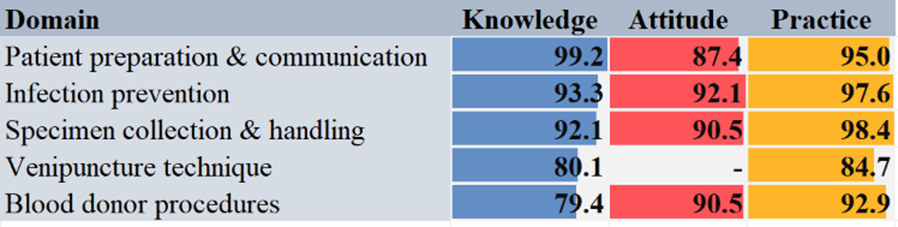
Fig. 1: Domain-wise average scores for knowledge, attitude and practical competency regarding phlebotomy among BSc MLT students
DISCUSSION
In the present study, a large majority of BSc MLT students demonstrated good knowledge (88.9%) and good practical competency (85.7%) in phlebotomy after completing the value-added course. Similar observations have been reported by Dey et al. and Adiga and Adiga, who found satisfactory overall knowledge among nursing personnel but identified deficiencies in technical aspects of phlebotomy despite routine clinical exposure[3, 6].
Across all three domains, venipuncture technique scored the lowest, both in knowledge (80.0%) and in practical competency (84.7%). Among the individual components, knowledge regarding palpation after skin disinfection was particularly low (54.0%), highlighting an important area requiring reinforcement. Coşkun et al. and other studies also reported Similar deficiencies in venepuncture technique and adherence to standard blood collection procedures among nursing personnel and practising phlebotomists[2-4]. Repeated supervised practice and competency-based assessment may help improve these technical skills while ensuring adherence to recommended venepuncture guidelines[1].
Positive attitudes were observed across all competency domains, although patient identification and communication showed the lowest positive response (87.4%). Effective communication is an essential component of safe phlebotomy practice, particularly for obtaining informed consent and reducing patient anxiety. Role-play and simulated-patient training have been reported to improve communication skills, learner confidence and patient-centred practice during phlebotomy training[8-10]. Incorporating structured communication exercises into future value-added courses may further strengthen this competency.
High scores in infection prevention and biomedical safety (93.3% knowledge and 97.9% practical competency) and specimen collection and handling (92.1% knowledge and 97.3% practical competency) indicate good acquisition of the essential components of safe phlebotomy. Similar improvements in adherence to safety practices and standardised blood collection procedures have been reported following structured educational interventions[7, 8, 10]. The combination of mannequin-based simulation and supervised clinical training used in the present study may have contributed to these outcomes. Previous studies have also shown that simulation-based practice, followed by supervised clinical exposure, improves procedural skills and confidence among undergraduate learners[10, 13].
Overall, the domain-wise assessment suggests that structured practical training combined with supervised clinical exposure can strengthen phlebotomy competency among undergraduate BSc MLT students. The domain-wise assessment identified specific gaps, particularly in venepuncture technique and patient communication, which can be addressed through focused refresher sessions, repeated supervised practice and periodic objective competency assessment[7, 8, 11]. As this study was conducted at a single institution and assessed students immediately after the course, further studies including larger numbers of students across different institutions and educational settings, with emphasis on the competency gaps identified in the present study, would help determine the effectiveness of such educational interventions and their wider applicability.
CONCLUSION
BSc Medical Laboratory Technology students demonstrated good knowledge (88.9%), favourable attitudes and satisfactory practical competency (85.7%) following completion of the value-added phlebotomy course. The competency was highest in the patient preparation, infection prevention, and specimen collection and handling, whereas comparatively lower scores in venepuncture technique and patient communication identified areas requiring additional reinforcement. These findings support the inclusion of structured value-added training with supervised practical exposure as a supplement to routine undergraduate teaching. Further studies involving larger numbers of students across different institutions and educational settings are needed to validate these findings and assess the wider applicability of this educational approach.
ANNEXURE I
Structured Questionnaire for Assessment of Knowledge, Attitude and Practical Competency in Phlebotomy
Section A. Knowledge (Response: Yes/No)
- Patient identity (Name and UHID) is verified before blood sample collection.
- Venepuncture is performed by a trained phlebotomist.
- The antecubital fossa is the preferred site for routine venous blood collection.
- The median cubital vein is the preferred vein for routine venepuncture.
- All required equipment should be assembled before starting the procedure.
- The venepuncture site should be palpated again after skin disinfection.
- A 19- or 21-gauge needle is suitable for routine adult venepuncture.
- A needle insertion angle of 30°–40° is appropriate during venepuncture.
- Recapping a used needle with both hands is a dangerous practice.
- Blood samples should be transported to the laboratory in appropriate specimen containers.
- A lavender-capped vacutainer is used for haemoglobin estimation.
- Blood culture specimens should be collected first in the order of draw.
- Donors with a history of major surgery within the previous six months are temporarily deferred from blood donation.
- Universal precautions reduce the risk of blood-borne infections.
- Used vacutainers should be discarded according to biomedical waste management guidelines.
- Hepatitis C virus can be transmitted through contaminated/shared needles.
Section B. Attitude (5-point Likert scale: Strongly Disagree–Strongly Agree)
- Providing accurate information about venepuncture improves patient confidence.
- Informed consent should be obtained before venepuncture.
- Communicating with patients before venepuncture helps reduce anxiety.
- Post-phlebotomy care instructions should be provided to every patient.
- Blood donors should be selected according to standard eligibility criteria.
- Relevant history, including smoking and alcohol use, should be obtained before blood donation.
- Proper skin disinfection is essential before venepuncture.
- Blood donor units should be collected in CPDA-containing blood bags.
- Blood samples collected in anticoagulant vacutainers should be mixed by gentle inversion.
- Timely transport of blood samples reduces pre-analytical errors.
Section C. Practical Competency Checklist (Rating: Satisfactory / Needs Improvement / Unsatisfactory)
- Verifies patient identity and laboratory request form.
- Selects appropriate collection tubes and assembles equipment.
- Positions the patient, applies the tourniquet and identifies the vein.
- Performs hand hygiene and wears gloves.
- Cleans the venepuncture site correctly.
- Inserts the needle at the appropriate angle with bevel facing upwards.
- Stabilises the vein and establishes blood flow.
- Releases the tourniquet at the appropriate time.
- Withdraws the needle safely and manages the puncture site.
- Observes the patient throughout the procedure.
- Performs blood donor selection according to standard criteria.
- Collects blood in donor bags with appropriate anticoagulant mixing.
- Disposes of used needles in the puncture-proof sharps container.
- Assembles the mannequin and equipment for simulation.
- Positions the mannequin and identifies the simulated vein.
- Performs venepuncture correctly on the mannequin.
References
1. Clinical and Laboratory Standards Institute (CLSI). Collection of Diagnostic Venous Blood Specimens. 7th ed. CLSI standard GP41. Wayne (PA): Clinical and Laboratory Standards Institute; 2017.
2. Coşkun C, Gümüş A, Uçar KT, Düz ME, Yeşil BS, Özkan A, et al. Assessment of blood collection competency in phlebotomists: a survey study. Turkish Journal of Biochemistry. 2025; 50 (2). Available from: https://doi.org/10.1515/tjb-2024-0322
3. Adiga U, Adiga S. Assessment of Knowledge and Skills of Phlebotomy Technique among Nursing Staffs of a Teaching Hospital. IOSR Journal of Biotechnology and Biochemistry. 2017; 03 (02). Available from: https://doi.org/10.9790/264x-03021012
4. Crous L, Armstrong SJ. The bloody truth: Investigating nurse phlebotomy competencies at a private laboratory in Johannesburg, South Africa. Health SA Gesondheid. 2016; 21 Available from: https://doi.org/10.1016/j.hsag.2016.06.002
5. Alizai SA, Sadaf R, Atif M, Shehzadi K, Noor N, Saeed M. Phlebotomy- A gateway to laboratory diagnostics. Pakistan Journal of Pathology. 2024; 35 (1). Available from: https://doi.org/10.55629/pakjpathol.v35i1.790
6. Dey S, Rai N, Bansal A, Kumari B, Das B, Kumari A. A Knowledge, Attitude, and Practice (KAP) Study on Phlebotomy Among Nurses in a Tertiary Hospital in Patna, India. Cureus. 2023; 15 (12). Available from: https://doi.org/10.7759/cureus.50372
7. Aykal G, Esen H, Yeğin A, Öz C. The results of a close follow-up of trainees to gain a good blood collection practice. Journal of Medical Biochemistry. 2019; 0 (0). Available from: https://doi.org/10.2478/jomb-2019-0053
8. Bölenius K, Brulin C, Graneheim UH. Personnel’s Experiences of Phlebotomy Practices after Participating in an Educational Intervention Programme. Nursing Research and Practice. 2014; 2014 Available from: https://doi.org/10.1155/2014/538704
9. Shimizu Y, Matsumura E, Tachibana S. Current Status of Phlebotomy Training Among Novice Nurses in Japan: A Survey Analysis. Cureus. 2022; 14 (8). Available from: https://doi.org/10.7759/cureus.28100
10. Medalla K, Mon W, Viepadan A. Phlebotomy in Practice: Evaluating the Impact of Timetabled Clinics on Medical Student Venepuncture Skills. Cureus. 2026; 18 (4). Available from: https://doi.org/10.7759/cureus.107400
11. Lin SY, Schillinger E, Irby DM. Value-Added Medical Education: Engaging Future Doctors to Transform Health Care Delivery Today. Journal of General Internal Medicine. 2015; 30 (2). Available from: https://doi.org/10.1007/s11606-014-3018-3
12. Shrivastava SR, Shrivastava PS, Tiwade Y. Shifting from Conventional Curriculum to Value-based Medical Curriculum: Narrative Review. Journal of Pharmacy and Bioallied Sciences. 2024; 16 (Suppl 2). Available from: https://doi.org/10.4103/jpbs.jpbs_1232_23
13. Widyandana D. Developing low-cost mannequin for undergraduate IV line phlebotomy. Jurnal Pendidikan Kedokteran Indonesia: The Indonesian Journal of Medical Education. 2018; 7 (3). Available from: https://doi.org/10.22146/jpki.41842
Copyright
©2026 Sneha, et al. This is an open-access journal, and articles are distributed under the terms of the Creative Commons Attribution License CC-BY 4.0. (https://creativecommons.org/licenses/by/4.0/) which permits unrestricted use, distribution, and reproduction in any medium, provided the original authors and source are credited.
Cite this article
Sneha K, Supreetha MS, Hemalatha A. Educational Evaluation of a Value-added Course on Phlebotomy Among BSc Medical Laboratory
Technology Students. Perspectives in Medical Research. 2026; 14(2):45-49 DOI: 10.47799/pimr.1402.26.43